Define what occasional use means
Distinguish a table opened once a month for paperwork from a daily workstation that must disappear every evening. Daily changeovers make locking, carrying and storage recurring tasks. Count the steps once: remove equipment, secure the table, fold, carry and store it. Repeat setup in the reverse direction.
If another household member needs the room earlier, clearing the area should not require lengthy preparation. Keep loose documents together in a folder and leave the intended storage position available. A folded top behind other furniture may be stored but is not readily accessible. Decide from the actual frequency of change whether the folding solution retains its space advantage in everyday use.
Check the route into storage first
Measure the place where the folded desk will live. Include the folded depth of feet, handles and catches. A product described as fitting behind a door may prevent that door from opening fully. Put a box of similar dimensions in the intended location and test access before settling on a model.
Consider who will move the desk. Weight is only part of the task: a broad top may be difficult to carry down a narrow passage even if it is fairly light. Check the intended carrying position and available grips in the instructions. Furniture that needs an awkward carrying operation each time is likely to stay open more often than planned.
Understand the complete mechanism
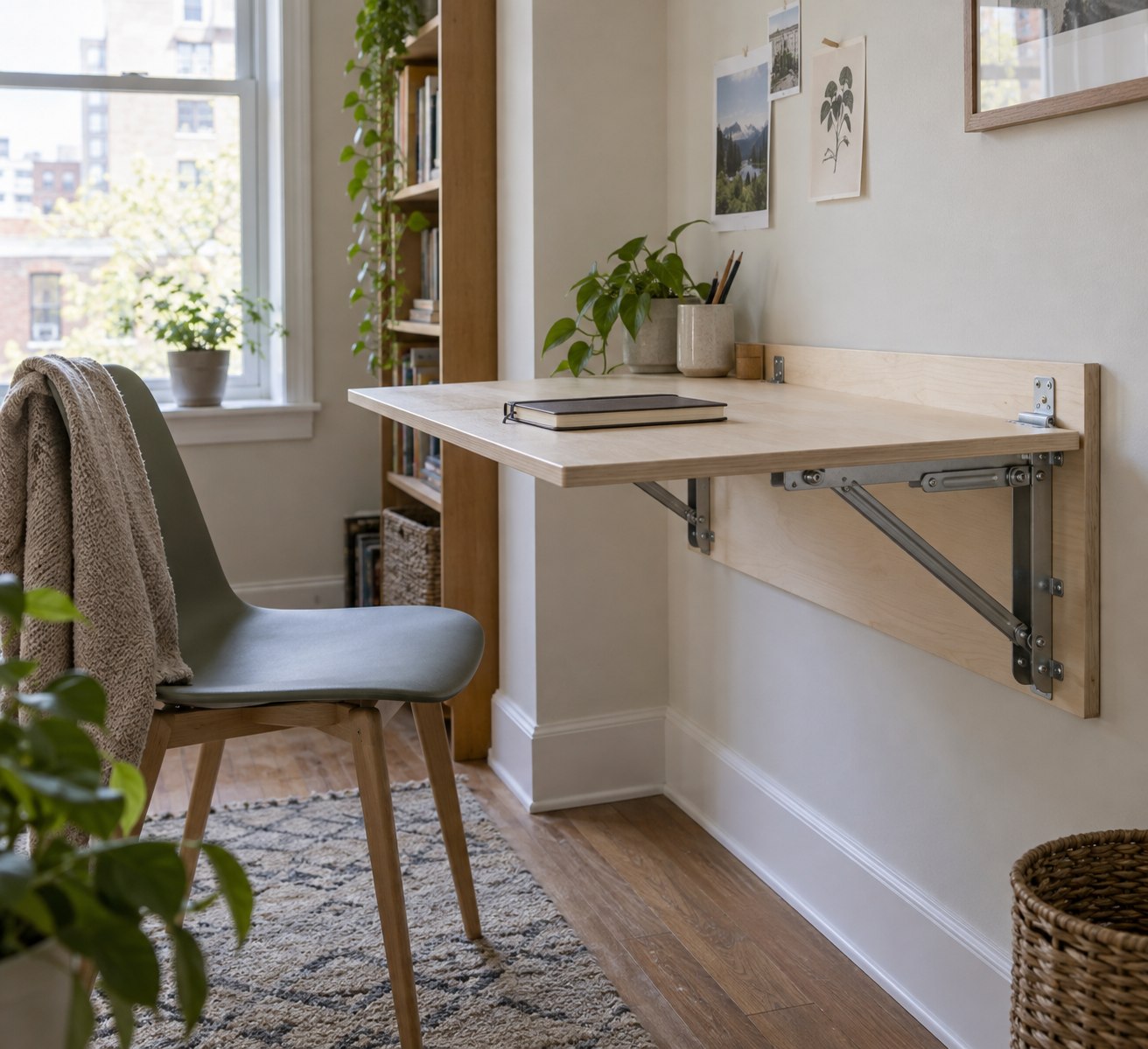
Ask how the legs or top lock into position and how to recognise a correctly secured setup. Follow the specified assembly sequence. Do not use the desk with supports only partly engaged. Look for understandable instructions and confirm that all required locking components are included.
Try the movement in a clear area. Keep fingers and cables outside the closing path. With a second-hand model, establish that locking parts are complete and unmodified. Improvised replacement parts or a mechanism that holds only when forced are poor starting points for a surface that will move regularly.
Test ordinary tasks when it is open
Assess the desk on the type of floor where you will use it. Type a few sentences and operate the mouse. The front edge should not visibly sway with every input. Compare the permitted load with your equipment and paperwork. A rating for another model in the same range cannot simply be transferred to this one.
Decide what must be removed before folding. A permanently mounted monitor arm or screwed-on cable tray may obstruct the mechanism. For occasional use, a fully removable work kit can be easier to manage. Give that kit its own storage location as well. The room becomes available again only when both the desk and the working materials can be put away. Rehearse the full sequence once, including moving the chair, so that the time and effort involved are clear.